

Often there are terms in screenwriting that do what they say on the tin. The bookend technique fulfils this mantra. It’s a plot device used to sandwich a story like two bookends.
But what exactly does the bookend technique look like in screenwriting? And how can you deploy it? In this article, we will help you understand the bookend technique and how to use it in your own writing.
To do this, we will take three easy steps.
- Teach you what the bookend technique is and why it’s widely used.
- How and why writers have used it.
- A deeper look into some uses of the bookend technique.
By looking at some films and the way they use the bookend technique, we’re going to show you how to deploy the technique in your own screenplay.
Table of Contents
What is the Bookend Technique?
The bookend technique is a framing device used in many forms of storytelling, be it film, television, poetry or novels.
The device frames the whole story by linking the beginning and end in some way. This is done by having the beginning and the end of the film mirror each other. This can be a straight replica of the frames. Or it can be similar sequences or scenes, and even more subtle mirroring.
The bookend technique is very similar to, and in many cases, there is a direct overlap, with some other storytelling techniques, devices and principles. For clarity, let’s take a look at how…
Circular Storytelling
Circular storytelling is a narrative structure that has the protagonist of a story return to where the story started.
The idea is that it emphasizes the protagonist‘s progression by juxtaposing them at the beginning with them at the end. Thusly, it demonstrates the journey they have been through and how much they have changed internally, despite their circumstances seeming the same externally.
For example…
- Parasite – The family has to return to the basement where they originally lived after infiltrating a rich family and their home.
- Gone Girl – Amy and Nick Dunne stay married after she returns from framing him for her death.
Chekov’s Gun
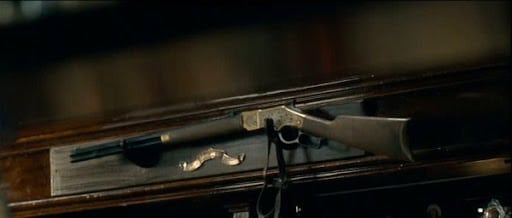
The bookend technique can also be tied to the dramatic principle of Chekhov’s Gun.
The principle is that there should be no redundant parts in a story. Therefore, everything in the story must be completely needed. If you’re going to place a gun in the first act, it must be fired in the third.
The bookend technique is inherently a use of Chekhov’s Gun principle. This is because it is essentially a setup and payoff, using the meaning from the beginning at the end of the story.
A Frame Story
A frame story is a technique used often in literature, though there are many films that have adopted it also.
The definition of a frame story is put best by Raymond Malewitz.
“As its name suggests, a frame story is a narrative that frames or surrounds another story or set of stories. It usually appears at the beginning and end of that larger story and provides important context and key information for how to read it.”
Raymond Malewitz
For example, films that have used this technique include:
- Forrest Gump – At the beginning of the film he tells the story of his childhood til the present day from a park bench.
- Titanic – Rose recounts the story of the sinking RMS Titanic to a researcher.
- The Princess Bride – The grandfather of a sick young boy reads a fantasy tale to cheer him up.

Members only
This article continues in our Members Area
Join SCREENWRITING: EVOLVED for full access to 700+ guides, whitepapers, the script library, industry interviews and much more.
Join SCREENWRITING: EVOLVED — just $9.99/monthCancel any time · No commitment
Not ready to join yet?
Comments are closed.