

Harry Potter and the Prisoner of Azkaban Script: Free Screenplay PDF
Read the Harry Potter and the Prisoner of Azkaban Script FreeFree. You’ll also get our screenwriting newsletter.
Harry Potter and the Prisoner of Azkaban is widely considered one of the best Harry Potter films. Directed by Alfonso Cuarón from Steve Kloves’s screenplay, it follows Harry’s third year at Hogwarts as the escaped prisoner Sirius Black, said to have betrayed Harry’s parents, comes looking for him, and soul-sucking guards called Dementors patrol the school.
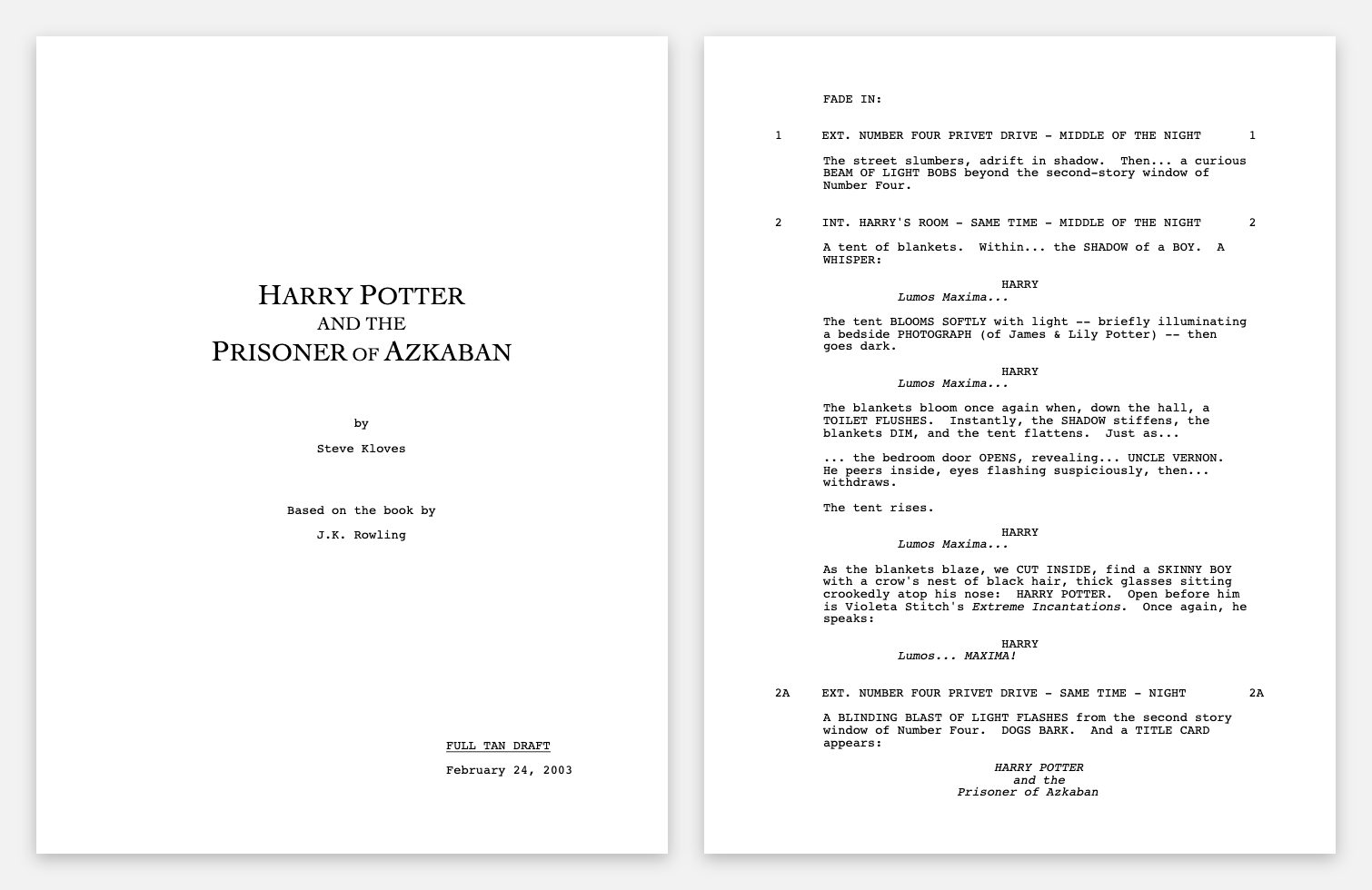
Here you can download the Prisoner of Azkaban script as a free PDF. It is 128 pages long. Read it for its darker tone, its mystery about Harry’s past and its ingenious time-travel climax.

Get the Whole Collection
Grab 1,000+ produced scripts in a single download.
Hunting down scripts one by one takes forever. Get Harry Potter and the Prisoner of Azkaban along with 1,000+ other film and TV scripts, including Oscar winners, TV pilots and Black List scripts, all organised by genre.
- One-off payment of $35
- Instant download
- Yours to keep forever
Harry Potter and the Prisoner of Azkaban: Official Trailer
The video below is the official trailer from the Harry Potter channel. Watch it, then notice how much darker and more atmospheric this film is than the first two, reflecting Harry’s growing up and the darker turn of the story.
Why Writers Should Read This One
Prisoner of Azkaban is a mystery about the past that pays off with a time-travel twist. Reading the script shows how carefully the writers plant clues for the final act. Grab the complete PDF below.
Harry Potter and the Prisoner of Azkaban Script: Get It Free
We’ll email you the full 128-page script at no cost.
You’ll get our free screenwriting newsletter as well; unsubscribe at any point.What Makes the Harry Potter and the Prisoner of Azkaban Screenplay Worth Studying
Aunt Marge
The film opens with Harry losing his temper and inflating Aunt Marge, then running away from the Dursleys. A hero who breaks the rules in anger shows that he’s growing up.
The Knight Bus
Harry escapes on the Knight Bus, a chaotic triple-decker that weaves through London traffic. It’s a comic set piece that also introduces Sirius Black’s escape. Combining comedy and exposition keeps information from feeling heavy.
The Dementors
The Dementors, prison guards who drain happiness, board the Hogwarts Express and leave Harry unconscious. They embody depression and fear. A threat that’s psychological as well as physical deepens a family film.
Professor Lupin
Lupin, the new Defence Against the Dark Arts teacher, becomes a mentor to Harry and teaches him the Patronus charm. He has a secret. A kind mentor with a hidden side keeps the audience guessing.
Sirius Black
Sirius is presented as a murderer who betrayed Harry’s parents. The truth is the opposite. A villain who turns out to be an ally is one of the most satisfying twists in storytelling.
Buckbeak
Hagrid’s hippogriff, Buckbeak, is condemned to death after injuring Draco. The subplot seems minor. It becomes central to the climax. Planting a subplot that pays off in the final act makes a story feel tightly built.
The Marauder’s Map
The twins give Harry a magical map that shows everyone in Hogwarts. It reveals a man who is supposed to be dead. A magical object that exposes a lie is a perfect mystery device.
The Shrieking Shack
In the Shrieking Shack, the truth comes out: Sirius is innocent, and the real traitor, Peter Pettigrew, has been hiding as Ron’s rat, Scabbers. The revelation scene reframes everything. A confrontation in which all the secrets come out is the classic climax of a mystery.
Lupin’s Transformation
Under the full moon, Lupin turns into a werewolf, and Pettigrew escapes. The triumph turns to disaster. A reversal at the moment of victory raises the stakes for the final act.
The Time-Turner
Hermione reveals she has been using a Time-Turner to attend extra classes. She and Harry travel back in time to save Buckbeak and Sirius. The audience sees earlier scenes from a new angle. Time travel that loops back to explain earlier mysteries is a brilliant structural device.
The Patronus
Harry believes he saw his father cast the Patronus that saved him. In the time loop, he realises it was himself. A hero discovering that the help he was waiting for was his own strength is the story’s emotional climax.
Cuarón’s Style
Alfonso Cuarón brought a looser, more naturalistic style to the series, with long takes and students in casual clothes. A director’s vision can transform how a script plays on screen.
Hermione’s Secret
Hermione keeps appearing in classes she shouldn’t be able to attend, and dropping in and out of scenes. The audience notices but doesn’t understand. Planting small oddities that are explained in the climax rewards attentive viewers.
The Whomping Willow
The violent tree guarding the tunnel to the Shrieking Shack becomes a key location. A setting introduced in a previous film can return with new purpose.
Harry’s Parents
The film deepens Harry’s grief for his parents: he learns that their friend was believed to have betrayed them, and that his father’s friends are still alive. A hero’s past becoming personal raises the emotional stakes of a series.
Harry Potter and the Prisoner of Azkaban: Lessons for Screenwriters
Make the Threat a Misdirection
The whole film is built around Sirius Black, the escaped prisoner everyone believes is coming to kill Harry. The truth is the opposite: Sirius is Harry’s godfather and was framed. Building a story around a threat that turns out to be a protector creates one of the series’ best twists.
Give the Hero a Personal Stake in the Past
Harry learns that his parents were betrayed and that he has been told the wrong story about who betrayed them. The past becomes the mystery. A story where the hero uncovers the truth about their own history has built-in emotional stakes.
Introduce a Mentor With a Secret
Remus Lupin is the best Defence Against the Dark Arts teacher Harry has had, and he hides the fact that he is a werewolf. His secret pays off at the climax. A mentor with a hidden side keeps the audience guessing about his role.
Use Time as a Plot Device
Hermione’s Time-Turner lets her and Harry relive the evening and change its outcome. The second time through, scenes the audience has already seen take on new meaning. Time travel works in a story when the rules are clear and the replay reveals things the first pass hid.
Plant Clues for the Loop
Small odd details in the first run, like the stone that hits Harry and the sound outside Hagrid’s hut, are explained when the characters revisit the scene. Planting effects before their causes is one of the joys of a time-loop structure.
Let the Hero Save Himself
Harry thinks he saw his father cast the Patronus that saved him at the lake. On the second pass he realises it was himself. The moment completes his arc of confidence and turns the time travel into character growth.
Change the Visual Tone
Director Alfonso Cuarón gave the third film a darker, more grounded look, with the students in ordinary clothes and the school set in a wilder landscape. A sequel can refresh a series by changing its style to reflect the characters growing older.
Leave the Villain Free
Peter Pettigrew escapes at the end, and Sirius has to flee. The victory is partial. Ending a middle chapter with the threat still at large keeps the larger story moving.
Turn Fear Into a Lesson
The Dementors affect Harry more than anyone else because of what he has lived through. Lupin teaches him the Patronus charm by asking him to hold on to a powerful happy memory, and the training scenes double as a story about facing trauma. Linking a magical skill to the hero’s emotional state means every attempt to cast it says something about how he is coping. Writers can use the same idea in any genre, tying a practical skill to an inner struggle.
Hide the Real Villain in a Pet
Ron’s rat, Scabbers, has been in the background since the first film. He turns out to be Peter Pettigrew, the man who really betrayed Harry’s parents. Hiding the answer to a mystery in a character the audience has stopped noticing is one of the most satisfying reveals a writer can pull off, provided the clues are there to find on a second viewing.
A Note on This Script
The screenplay is by Steve Kloves, adapting J.K. Rowling’s novel. Alfonso Cuarón directed, after making Y Tu Mamá También, and later won the Oscar for Gravity.
This film introduced Michael Gambon as Dumbledore and Gary Oldman as Sirius Black.
The Big Scenes in Harry Potter and the Prisoner of Azkaban
- Privet Drive. Aunt Marge.
- The Knight Bus. Escape.
- The train. The Dementors.
- Hagrid’s hut. Buckbeak.
- The map. Peter Pettigrew.
- The Shrieking Shack. The truth.
- The lake. The Patronus.
- The time loop. Saving Sirius.
Read Scripts in Bulk Instead
Download 1,000+ classic scripts instead.
No more trawling the web for PDFs. Get Harry Potter and the Prisoner of Azkaban and 1,000+ more produced film and TV scripts, Oscar winners, TV pilots and Black List scripts included, filed by genre in one download.
- One-off payment of $35
- Instant download
- Yours to keep forever
Harry Potter and the Prisoner of Azkaban Script FAQs
Who wrote the Prisoner of Azkaban script?
Steve Kloves wrote the screenplay, adapting J.K. Rowling’s novel. Alfonso Cuarón directed.
How many pages long is the Prisoner of Azkaban script?
The PDF is 128 pages.
Who plays Sirius Black?
Gary Oldman.
Is this the third Harry Potter film?
Yes.
Get the Harry Potter and the Prisoner of Azkaban Script Free
Enter your email for the full 128-page script, free.
Signing up also adds you to our free screenwriting newsletter. You can leave any time.Harry Potter and the Prisoner of Azkaban Screenplay Facts
| Screenplay | Steve Kloves |
| Based on | the novel by J.K. Rowling |
| Length | 128 pages |
| Director | Alfonso Cuarón |
| Studio | Warner Bros. |
| Released | 2004 |
More Scripts to Read Next
Into Harry Potter? Read Harry Potter and the Chamber of Secrets script. Into fantasy? Try Return of the King script. Writing a family fantasy? Send your script for script coverage and our readers will tell you whether your mystery works.
Hunting for another title? Search the free script library by writer, genre or name.
Note: any analysis on this page refers to the finished film. The screenplay PDF may be an earlier or later draft, so scenes, dialogue and page numbers may differ from what you see on screen. The screenplay is the work of its credited writers and rights holders; it was not written by Industrial Scripts.